Landri Fae Harmon
NIU Graduating Class of 2027
PRIM Intro Art & Desg: Cont & Clin Exp
Art Education 442

Image Source: Google Images
Jan. 14, 2026
Introduction to Art Education
When taking a look at “visual culture”, I tend to automatically think it’s art. It’s visual art, to put it in simple terms, not just traditional art. It includes any kind of art, from drawings and jewelry making to social media and designs found on our beloved Starbucks mugs. We are constantly surrounded by it daily, and we are even consumed by it in the palm of our hands, also known as our phones and electronics.
Not only are we always engulfed in it, but it’s crucial to learn as well as incredibly important to teach our students. It directs our minds to comprehend the world around us as well as begin to think creatively, effectively, and critically. As the book mentions, “Visual culture can be both obvious and subtle in its influence. Signs and symbols are an overt part of visual culture designed to help us find our way around in the world. Advertising images may be more subtle but are nevertheless intended to influence our behavior in the marketplace” (Freedman, Boughton, ch.1, p.7). Lots of us, especially younger children, don’t necessarily notice how influenced we are by a simple advertisement or piece of artwork until we’re buying it or recreating it ourselves. We, as future educators, can take that idea and push it forward into our teachings as others do.
“Visual culture is by its nature powerful, pervasive, and intrusive. To be effective in helping students to understand its impact on their own lives and the lives of others necessitates a perspective of art education that is socially relevant. The aim of a socially relevant perspective is to improve the lives of individuals and social groups, to promote democratic debate about issues and conflicts, and to help students take responsibility for their own learning” (Freedman, Boughton, ch.1 p.32). Visual culture not only is powerful, pervasive, and intrusive as it says in the book here, but it’s helping students to make something of themselves. They can interpret the world in their own ways and recreate it how their imaginative minds thought it through art. Art is a very powerful tool within itself, and being able to represent that in visual culture is just the more reason why it’s so important to continue teaching intriguing topics such as this one.
Jan. 21, 2026
Making and Viewing Visual Culture
What to make of visual culture as well as viewing it today is completely different than say 10-15 years ago. Children today encounter more forms of visual culture than what was ever seen in the past due to one simple factor, technology. The advancement of technology over the years has improved tremendously and has allowed increased access to visual culture for children over a period of time. Phones, tablets, computers, television, and technology of all kinds provide access to an endless amount of content to kids that is none other than visual culture. Those, such as parents and early generations, did not have this kind of access to visual culture. Instead, they experienced it more so through newspapers, posters, magazines, etc.
As art educators teach, they have to not only include their own personal experiences and interpretations of what they see in art, but they also have to consider that today’s generation and others are learning that much differently compared to how it used to be. As it states in Chapter 2, “Each of these is a reasonable avenue to interpretation. At the elementary level, some interpretations may seem as if they have little to do with an artist’s intent, but a personal interpretation is certainly valid” (Freedman, Boughton, ch.2, p.11). Everyone, whether you’re an 8-year-old girl or a 35-year-old man, depicts what they see differently. As future educators, we have to always keep that in the back of our minds. This not only contributes to how kids see art, but also how they view the world and what to make of it based on their experiences and situations they’ve found themselves in. “The symbolic meanings of visual images and objects shape the way students think about the world, and when taught well, can enrich and expand both interdisciplinary and discipline - specific knowledge (Freedman, Boughton, ch. 2, p.29).
As a future elementary art teacher in today’s generation, there is so much to learn and take on as someone who is to teach younger generations of great things that lie within art and the culture around them. Take Andy Warhol’s artworks, specifically the Campbell Soup Cans. To an adult, it’s simple, sophisticated, well done, but to a child, it’s colorful, fun, creative, and recognizable enough to recreate it themselves in their own ways. We can take these interpretations from children, and render them to help emphasize to the littles the importance of art and what influences them to see artwork the way they are seeing it.
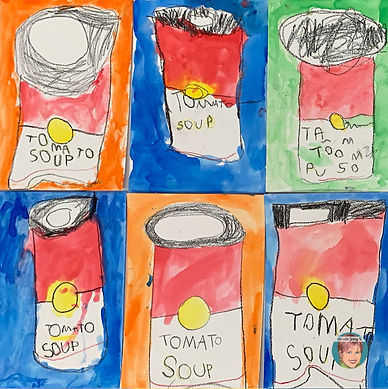
Image Source: Google Images

Image Source: Google Images
Community, Culture, and Critique
Jan. 26, 2026
Each person views the world differently, let alone an entire community. Someone may see praying to God as a very important aspect of their life, whereas someone else could see spending time with their pets as just as important. It all comes down to you, who you are, and what you believe in. Now, let’s talk about art and how this can relate in that aspect. Let’s look at visual culture. Visual culture reflects a variety of definitions and diverse roles in art within societies by showcasing their values, beliefs, and practices. As it states on page 2 in Chapter 3, “Cultural groups use visual culture as a way to reveal similarities within the group, express membership in the group, and express individual differences among members of the group. Cultural beliefs and practices are transmitted formally and informally through visual culture from generation to generation, each generation maintaining communal aspects of the group” (Freedman, Boughton, ch.3, p.2). Some cultures view the world through the eyes of their culture. If you can express yourself within the culture by using something as expressive as art, that makes you that much more important in their eyes. People, especially those who step foot on earth before us, see art as an everyday thing, a daily function to their day if you will. It helps them to feel connected to their spirituality as well as guide generations after them to see how something as beautiful as art is incredibly important to have in their lives. As for others, it may be valued for its aesthetic qualities, serving more as a form of personal interest or a topic of gossip. The subjects, styles, materials, and formal ideas that are used in visual culture today tend to carry a message with the work or represent a symbolic form.
Now, how can we, as future elementary educators, introduce visual culture to students, specifically younger students, without it being confusing? Well, to start off, being able to introduce elementary students to a certain “range” of visual culture representing diverse cultural groups is incredibly crucial to their learning. On page 11 in Chapter 3, the authors state, “Although different cultural groups make similar types of visual culture, educators must be careful to help students understand the diversity among art forms as well as similarity. For example, many cultures use masks, but children’s use of Halloween masks is quite different from the use of African or Native American masks for important ceremonies” (Freedman, Boughton, ch.3, p.11). It broadens their understanding of the world around them as well as what else is out in the world, it promotes emotions and empathy for others, and even gives them a chance to feel important or feel included in something big. How do we do that? By gently exposing the different cultural aspects through three things: art, media, and imagery. This will help the child recognize and enjoy what life has to offer them outside of their world here in Illinois, or wherever they happen to live. An early introduction to this topic, especially at an elementary level, is a great thing to do. It encourages them to respect other cultures and the way they live their lives, as well as allows them to enjoy art that much in a different manner.
Artistic Development and Identity Construction
Jan. 28, 2026
Psychologically, artistic development over time reflects cognitive growth. As the children begin to mature and take notice of their skills, their abilities to understand and represent the world change drastically. Younger children’s art is more symbolic than it is realistic. Older children are different as they have the mental capacity to do detailed and representational work to show their improvement over time. The book mentions something incredibly crucial to consider as well while teaching a child in art. In Chapter 4, page 9, it mentions, “...three major stages of child development. The scribbling stage (age 2-4), the figurative stage (age 3-12), and the stage of artistic decision (11 +)” (Freedman, Boughton, ch.4 p. 9). This part of the book suggests the idea that there are stages within a child when it comes to art. This serves as a part of their cognitive growth and mindset. They begin to understand the bigger picture and how the world around them becomes real and not just a bunch of scribbles. They begin to understand the world and see it creatively as well as realistically. Art also serves as an opportunity for emotional expression and allows the littles to express what’s in their minds. Children especially use art to communicate their feelings that may be difficult for them to express in words or sentences in general. Art is an “emotional outlet" that’s crucial for the psychological well-being of a child and can be observed through many things, such as colors, themes, how they paint, how they draw, etc. Art can also serve as a form of conversation and social commentary for a child. It gives them, once again, another chance to express themselves in a verbal aspect. One child can draw a cat, and when their best friend sees they did that, their whole afternoon could be consumed by the conversation of just that drawing of a cat. It’s a great opportunity for kids to really become social as well as make new friends for life down the road.
But we also have to consider the sociological side of art development. We look more at the ideas behind social interaction, as well as, once again, as I mentioned above, social commentary. Social interaction plays an incredibly important role in a child’s life as well as within their artistic development. Being able to collaborate with their friends, receiving praises and other ideas from their teacher, or even being able to put their artwork in art shows, all help to represent how much social interaction can become a part of their artistic lives. Even the little things like this go a long way for a kid, especially ones who are really little and just starting in school together. It influences the child to think creatively like others are as well, as help ease their mind of any anxiety of not being able to fit in with everyone else. Social commentary comes in and does the same thing as well. It helps the kid be able to express themselves, but in a different way. Not only will it help them with their social skills or their cognitive side, but it will also help them feel more connected with their life and their families. Lots of children love to draw pictures of their homes, their pets, their parents, and their siblings. They draw not only what they know, but also their way of life and how they live together. It’s their “culture” per se. It gives them a sense of relaxation and hope, as well as feeling loved and comfortable enough to draw that out to share with their peers.
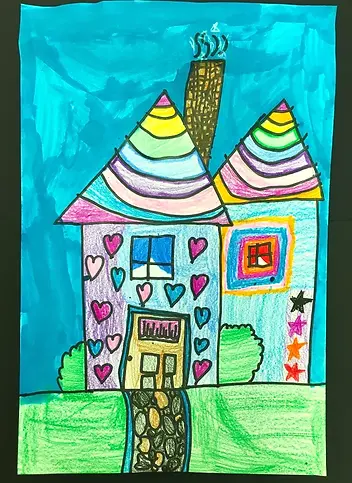
Image Source: Google Images

Image Source: Google Images
Curriculum Development and Lesson Planning
Feb. 02, 2026
The art curriculum, especially in today’s generation with high tech technology, has changed a great deal. As the world continues to change rapidly every day, creativity and being able to adapt to the life around us are highly valued skills. The art curriculum helps to emphasize many key factors in a child, including their creativity, their critical thinking, their communication skills, and even their emotional/social abilities.
Art, specifically Art Education, provides a unique opportunity for teachers to educate students and allow these skills to grow by encouraging them to think outside the box and take chances with new ideas.“Teaching content is part of the process of curriculum and involves the ways in which we help students to understand and use concepts and skills, which includes facts, emotions, ideas, images, techniques and processes, thinking skills, and so on” (Boughton, Freedman, ch.9 p.13). Critical thinking is also promoted as well as problem-solving. Art Education encourages students of all ages to analyze, interpret, and evaluate their own artworks as well as reflect on what they have done to get to the finished product. Simple things like a group critique help students develop stronger critical thinking skills, which are very important in all areas of their lives.
As a future art educator, it’s our job to not only encourage students in all aspects of their skills, but it’s also our jobs to provide them with work and an endless amount of chances to do so. Art projects often involve lots of important skill work as well as motivate the mind to think beyond what they do on a daily basis. Projects often allow for collaboration work, involve communication skills, listening to others’ feedback, and working with peers to achieve the common goal of creating a unique piece that is truly their own. Skills such as these are meant to be taught in art for many reasons, but mainly for success in both academic and professional places in life. It also allows for children to be happy and filled with laughter as art easily provides a safe and supportive "environment" for them to be able to explore their emotions, their self-confidence, and how they view life through their eyes. They don’t feel judged and they don’t feel pressured to be amazing at art. Any and all kids love the chance to be themselves and let their minds wander free. With today’s world working at its fastest pace, we have to prepare these kids for what’s coming. We have to prepare them for the real world, and being able to educate them properly as well as allow them to feel free and happy is what will give them a successful life down the road.
Visual Culture Themes
Feb. 04, 2026
Visual Culture can significantly shape a child’s artistic ideas and production by providing them with a variety of options and ideas based on the world that goes on around them. What children see and how they conceptually take that idea in mind is a completely different story, but we can help bring that out in a child by having them reinterpret what they are thinking about based on what they see and think.
We can expose children to many different ideas to help expand their understanding of what art can be and could be in an environment. We can influence their choices of styles and techniques, but also help to encourage their own ideas, such as maybe they relate to a certain element in their culture because it reminds them of their favorite cartoon or favorite toy. We can take that notion and turn it into a great motivation for a child to do their artwork. We can also take the idea of letting toys influence a child as well. An example on page 18 in Chapter 5 explains an idea about Barbie. “Visual culture can help students to visualize the variety of occupations available to people. For example, although the original Barbie (created in 1959) was based on a German sex toy and she has impossible body proportions (which were changed in 1998 to reduce breast size and more closely mimic a contemporary supermodel), The Mattel toy company has long publicized the view that girls playing with Barbie, who is now sold in the guise of many professional roles, will come to understand the range of opportunities available to women. Barbie is even sold as an art teacher” (Boughton, Freedman, ch.5, p. 18). Barbie is a fantastic example of how visual culture can also reinforce certain stereotypes that maybe a child may see daily, but never question what other possibilities there could be. This can help shape a child’s perception of life and artistic expression based just on asking a simple question and learning more about what goes on in their life around them.

Image Source: Google Images

Image Source: Google Images
Classroom and Management
Feb. 09, 2026
As a future elementary art teacher, being the most important resource in an art classroom can really be stressful, but also very encouraging. We, as teachers, are incredibly important when it comes to teaching in a classroom, but more specifically, for an art teacher, we lay down the groundwork for anything and everything that is art-related in this world. We introduce kids to basic techniques that are needed down the road, we introduce materials and basic concepts for them to learn and understand, and so much more!
We set off that spark in kids and allow them to be creative when no other classroom can be as much. We are able to create a safe space that allows these children to explore and express themselves without having a constant fear of being judged and mocked by others. I want my kids to have a safe and secure place where they can roam their little minds and create something fantastic for all of us to see. Teachers are great when it comes to encouragement and support, but we’re even better when it comes to helping our students develop important skills for their futures. Examples can include critical thinking, developing their fine motor skills, learning how to solve a problem on their own, and so much more, all while making art accessible and enjoyable. Being able to be a teacher who cares about your students so deeply will also help your kids see not only how passionate and kind you are, but it will also encourage them to be invested and care as much as you do. “Perhaps nothing aids student learning more than having a teacher who genuinely cares about what they are teaching. Not only does it benefit students as a result of the depth of knowledge represented in the curriculum, but it influences students through the teacher's modeling of love for learning…The more you care about an art form, and the more knowledgeable you become, the better you can reflect on it and see its quality in the context of other similar forms” (Freedman, Boughton, ch. 11, p. 6). We aren’t just teaching art to these kids; we’re getting them started on an appreciation for creativity and expression within artwork as well as within themselves.
Creating with New Media
Feb. 11, 2026
With today’s generation so involved with technology, it’s bound to happen that we, as future teachers, will be experimenting with different technologies to create a project of some sort. But, being able to do that with items such as computers or iPads can really be beneficial if you think about it! We can easily express to the students, as well as show them, just how cool and expressive visual technology can be. They can learn so many skills based on anything that’s digital. Easy examples to look at are being able to learn how to create digital paintings, animations, or even introduce them to graphic design work. This, especially to elementary students, opens up a whole new world of artistic possibilities that go just beyond traditional materials such as paint and markers.
By being able to use these different tools and explore those skills, children are easily able to experiment with different detailed work as well. This can include the many different colors that are no longer limited to what is given, the textures that they can now create without messing it up by hand, the “undo button” that allows them to quickly undo a mistake, and even the multiple effects that a device can do will really allow a child to do whatever their little hearts desire. This encourages them to take more risks, think outside the box, and become even more creative on a whole new level. “As is the case with traditional media, students use digital media in many creative ways. Use of digital media can even provide greater incentives and more creative opportunities than traditional media for older elementary students to make art. When students reach late elementary school, they are often concerned about a lack of ability to draw realistically, and digital technology can assist students’ normal development of the traditional, technical skills required for realistic representation. Many students now have excellent computer skills by the time they enter elementary school, and they continue to build these skills as they progress through school” (Boughton, Freedman, ch. 7, p. 7).
Not only does it help them artistically, but introducing technology this way to them will also help them develop the digital literacy skills that they will most likely need down the road, especially in today’s world and beyond. They can start to really see how technology is not just a tool for playing games and watching YouTube channels, but it’s a really great way for them to be able to express themselves artistically and tell their own little stories visually rather than just letting it sit in their imaginations.
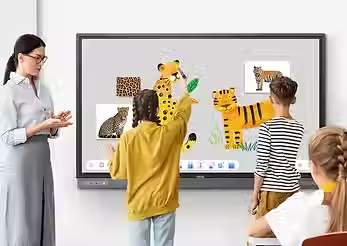
Image Source: Google Images

Image Source: Google Images

Image Source: Google Images
Understanding and Using Visual Qualities
Feb. 16, 2026
Visual Qualities, to put in simple terms, are the building blocks of anything you see in the world artistically. Examples can include things like the color you see in someone’s shirt, the shape of an apple in someone’s hand, the line that follows down the road in front of you, the texture in the grass after it’s been mowed, the space that’s between the letters on a billboard, or the value that’s found within a charcoal drawing. “Common elements are: color, line, value, shape, form, and texture. However, these elements are not mutually exclusive, as elements are considered in science. A shape, for example, can be made by a joined line or a patch of color. A line can be created by the edge of a mass of dark color set upon a light ground. A texture can be made by a pattern of shapes or lines. Value (light and dark) is also a property of color, line, and texture” (Freedman, Boughton, ch. 6, p. 6). These are your basic building blocks of life when it comes to art, and being able to understand these elements is key to really understanding not only the artistic life, but the visual life and culture that lies around you on a daily.
In an elementary art classroom, teaching these qualities to kids not only helps them to create their own artworks, but it also helps them to slowly, but surely, see the world around them differently. We can begin to encourage them to notice how these elements are used in everyday items, such as a couch or an ice cream cone, as well as art-based items, such as a poster or advertisement on TV. This understanding to you may be something simple, but to a child, it can be everything to them and more. This allows them to understand the world and think critically about what messages are being “told” through what visual qualities they see. “Students intuitively employ the tool of time as they make art in early elementary years. Such is their interest in narrative that they will often verbalize a story unfolding as they draw it. Teachers can play an important role in drawing the attention of students to the alternative ways in which time can be represented. Comic sequences and storyboards for short movies are helpful devices to explore the use of this tool. Following up storyboards with simple video movies or documentaries about school events or fantasy adventures can be great fun for students” (Boughton, Freedman, ch. 6, p.26). It allows the kids to then be able to develop their own opinions and creative responses based on what they have seen or do see as they are walking somewhere. It’s almost like giving them a tool and seeing if they can engage with the world even more by using this tool. What stories will they come up with? What tales will they draw out for us teachers to see and hear about? Visual Qualities are everything when it comes to art, and being able to express that and show that is something that a child can’t learn anywhere else. It’s our job as art teachers to educate them properly and do well.
Teaching that Promotes Learning
Feb. 25, 2026
There are lots of teaching methods out there, especially in today’s generation and beyond. With high-level technology and the advancement of the world going on, it’s without a doubt that teaching methods will be even more educational than they are now. But let’s talk about what teaching methods promote learning and education for kids in the present time.
What is the repertoire of instructional methods? Well, that’s a great question, as this can include many methods, such as lectures, discussions (both online and as a class), demonstrations, group work, peer critiques, case studies, simulations, and even inquiry-based learning. Being able to use a variety of teaching methods in your education to teach younger children is fantastic. For example, think specifically about teaching visual culture. It can cater to kids’ education in different learning styles, increase the students’ engagement within the lesson, deepen their understanding of the visual culture, and even help them to develop their critical thinking skills. You can easily take examples out of their everyday lives and put it into the teaching method you are going for within the lesson you’re going to teach. In this day and age, the best ways to connect with the kids and make your lesson that much more engaging are when you talk to them about Bluey, CocoMelon or Stranger Things. Pop Culture, TV Shows and Movies, Cartoons, etc. “All instruction at the elementary level should follow some general guidelines. Make sure that you use language that is appropriate for the developmental level. It helps to build knowledge when students are required to reach for the meaning of words, images, and objects, but this can only succeed when students encounter new information in contexts they have previously understood. In short, they need to be able to work from the known to the unknown. Always proceed in well-organized and easy steps. Allow enough time for practice and assimilation so students are able to construct new knowledge. Use questioning techniques like those discussed at the end of this chapter to establish levels of comprehension” (Freedman, Boughton, ch. 10, p. 11). All of these little things can really help to not only give a child a great way to connect with you and the lesson, but also these little things help to develop a child’s mind and help them to become more than what they are now, which is incredible.
What’s even more incredible is the fact that teachers can do even more than just their simple teaching methods to encourage the students and their minds even further, to push their limits. Teachers can enable and motivate students to review and rehearse their knowledge of visual culture through many activities, such as creating essays, participating in peer feedback and critiques, designing and presenting their own presentations, creating virtual projects, and so much more. There are many ways a teacher can motivate and encourage a kid to push past their limits in life, including the amazing teaching methods we have at our disposal. Each instructional method and learning moment helps a kid better understand the world around them and learn from it, which is what teaching is all about.

Image Source: Google Images
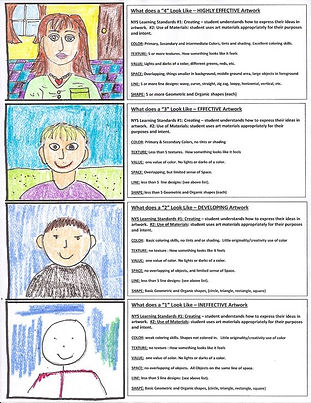
Image Source: Google Images
Assessment
Mar. 04, 2026
Haven’t you always wondered why assessments are always showing up in the form of a rubric? Why are they always here? What’s the point of them? How can this help students? Well, let me elaborate for you. When we focus on improving the students’ learning in art, we have to think about their sensitivity to the feedback as well as what’s appropriate for them to know and not know. For example, it’s probably not a good idea to tell a 3rd grade student that their artwork is not good and doesn’t make any sense according to the lesson and the directions given. When creating an assessment or a rubric, you have to have clear criteria. Make sure you have a clear goal set and ensure that your students understand what is expected of the project. You also have to keep in mind the different methods that are provided to assess the situation/artwork. We can use little things like self-reflections, critiques, or even a small portfolio to help the kids not only get a better understanding of what they should be doing, but it also helps us as teachers make sure everything is in order. Remember when I gave an example of a 3rd-grade student? Well, we were thinking in the right area, just in the wrong direction. Being able to
Giving constructive feedback is a great way for a student to learn and improve, but you have to be cautious about how you do it. As teachers, we can provide specific feedback that is also encouraging and focuses mainly on growth and skill development, rather than just saying we hate it, we love it, or even with a simple letter grade.
As you can tell, or maybe you already know, there are so many ways to assess a child as well as many ways to create an assessment/rubric. But, there are some that simply don’t work well or don’t work at all, and frustrate the students even more. Assessments that test conformity are a great example of it not working well, especially in a visually based culture program. Visual culture values tend to diverse interpretations, critical thinking, and individual expression. An everyday or standardized assessment/outcome does nothing for a student, as it limits their creativity, and they fail to recognize the whole point of the project itself. Having limited feedback for a student only worsens their artistic creation and silences their ideas. “Traditional assessment practices connect learning objectives to outcomes in a very tight relationship in which opportunities for 'thinking outside the box ' are almost always constrained. In this context, students strive to meet pre-stated objectives and do not define their own learning pathways. Therefore, in a visual culture curriculum, it is important for a different kind of relationship between curriculum and assessment to be developed. The most important learning objectives should be open-ended in nature to encourage divergent outcomes. To encourage idea development, expectations for students should be left open to negotiation. Assessment should take into account learning objectives stated by the teacher, but encourage and be responsive to unanticipated and idiosyncratic outcomes that have personal and social value” (Freedman, Boughton, ch. 12, p. 4).
Traditional Media
Mar. 18, 2026
Anyone and everyone has used a form of traditional media at some point in their lifetime, whether or not one thinks so. Especially younger children, they are bound to use traditional media all the time. Markers, pencils, paint, you name it, and I’m more than sure they’ve used it a few times. Elementary students need to experiment with more than just one medium! Being exposed to different materials allows a child to uniquely express themselves, as well as allow their imagination and creativity to run wild. Their fine motor skills will be enhanced in many ways, as being able to work with these different materials will allow their coordination and comprehension to improve significantly. It allows the kids to be able to solve their own problems if one happens to pop up, and think outside the box to figure out how to fix the situation at hand. It will help their confidence to grow and boost their self–esteem down the road, helping them to take bigger and bolder risks. Being able to interact with all of these textures and colors heightened their sensory perception as well as laid down a foundation for art. “They need to be able to refine their skills and develop the confidence of knowing techniques and processes peculiar to certain materials. Students may develop a strong preference for working in one medium as opposed to another. Because the production of art is highly dependent on the interaction of skills and concepts, students need to learn simultaneously how to use materials to convey ideas and how ideas can be expressed through various materials” (Freedman, Boughton, ch. 8, p. 7). When you start small and continue with it in your life, before you know it, you’re doing it without hesitation and doing it quite well. That’s how it can be for these younger children if we start introducing them to a variety of materials to use.
But, should we allow them to make as many decisions as they want to when it comes to art? Should it be free for all, or should there be limitations? Students should have the ability to do as they please and make their own choices about their art projects. Having someone else tell you exactly what to do can definitely ruin your creative mindset. Having ownership of your project makes you feel motivated and engaged that much more to reach a better outcome. It allows you to be able to solve any little problem on your own and learn from your mistakes. It improves your chances of taking risks and allows your students to experiment all they want to. Let your students have that freedom to do as they please. Let their confidence build and prepare them for a successful future. Give them endless opportunities to allow their minds to wander free and create something from their imagination.

Image Source: Google Images

Image Source: Google Images
Creating Meaning
Mar. 23, 2026
With technology advancing every single day, it’s bound to be that children experience many more forms of visual culture in today’s generation than they experienced in the past. Kids today are constantly surrounded by visual culture more than ever before for a few reasons. Smartphones, tablets, computers, and social media have become a very profound everyday object. It’s unavoidable. Platforms like Instagram, TikTok, and YouTube are very heavy visuals that are usually found to shape trends and influence communication in many different ways. Videos are also another form as they offer immersive visual experiences for kids, influence their storytelling skills, and even impact their design skills. There are many visual ads
all around us as well, from billboards and television to online ads and radio commercials, sometimes even specifically targeting children. It’s all around us, especially in today’s world. We live off of technology and act almost as if we can’t survive without it. Unfortunately, no matter how hard you avoid it, it’s bound to come into your life, and if not yours, your children’s lives.
But, being able to have a relationship between making and responding to visual culture is quite crucial for creating meaning, as well as for a child. “New knowledge is constructed through connections established by individuals and social groups between new information and previous knowledge. Support of the intimate, cognitive connection between emotion and knowledge revealed in and through visual culture is important to this process and is a part of student growth and development. The process of developing ideas is an important part of the creation of society and of sociocultural change” (Freedman, Boughton, ch. 2, p. 3). Making visual culture allows a child to communicate their ideas and express themselves differently. Responding to it involves interpreting and understanding those ideas, and when a child is able to comprehend that, it only influences their artistic life that much more. This shapes their understanding of the world and influences their cultural values as they continue with life down the road.